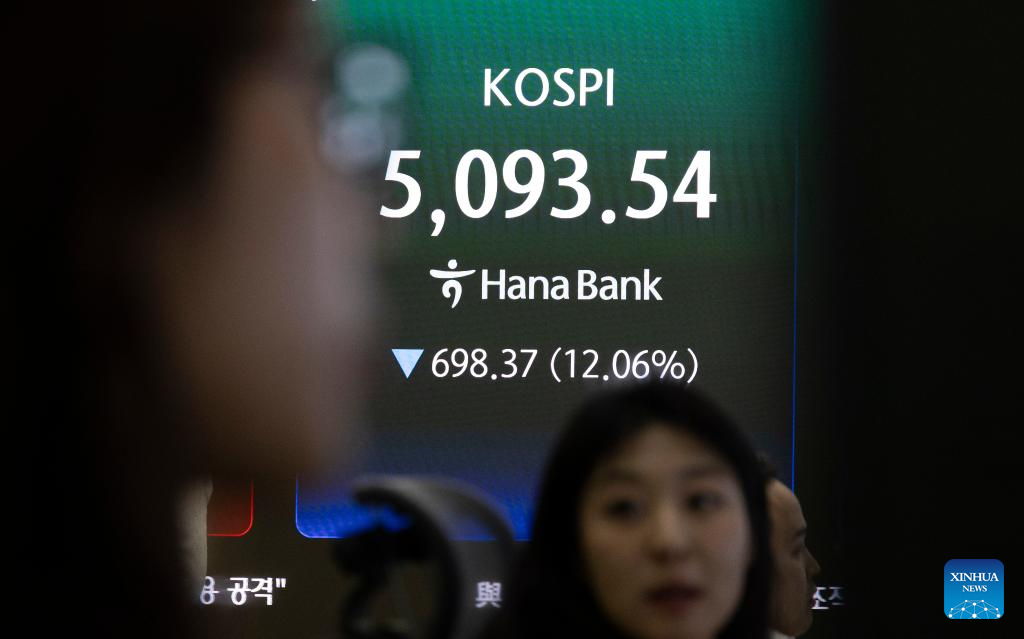
An employee works at the dealing room of Hana Bank in Seoul, South Korea, March 4, 2026. The Korea Exchange triggered circuit breakers on both the KOSPI and KOSDAQ markets following the severe market crash, caused by the escalating geopolitical tensions in the Middle East. The benchmark KOSPI dived 698.37 points, or 12.06 percent, to close at 5,093.54, and the smaller KOSDAQ plunged 159.26 points, or 14.00 percent, to finish at 978.44. Both the KOSPI and the KOSDAQ saw their steepest daily percentage drops in history. (Photo by Jun Hyosang/Xinhua)
SEOUL, March 4 (Xinhua) -- South Korean stocks tumbled more than 12 percent on Wednesday amid circuit breakers, triggered by escalating Middle East conflict that led to panic selling for the second straight session.
The benchmark KOSPI dived 698.37 points, or 12.06 percent, to close at 5,093.54, and the smaller KOSDAQ plunged 159.26 points, or 14.00 percent, to finish at 978.44.
Both the KOSPI and the KOSDAQ saw their steepest daily percentage drops in history.
On the previous day, the KOSPI and the KOSDAQ plummeted 7.24 percent and 4.62 percent, respectively.
The Korea Exchange activated circuit breakers on both the KOSPI and KOSDAQ markets in the morning session due to the severe market crash, caused by the escalating geopolitical tensions in the Middle East.
The level 1 circuit breaker was activated in the KOSDAQ at 11:16 a.m. local time (0216 GMT), and the circuit breaker was also issued in the KOSPI about three minutes later.
The level 1 circuit breaker is triggered when the index drops more than 8 percent for at least 1 minute to suspend trading for 20 minutes, while the level 2 is activated when the index plunges 15 percent or more for over 1 minute to halt trading for 20 minutes.
After the 20-minute suspension, trading resumes following a 10-minute single-price auction period.
The level 3 is triggered when the index drops 20 percent or more, and the trading is closed for the day.
Institutional investors led the sell-off in the KOSPI, but foreign investors engaged in dip-buying to prevent a deeper rout on both the KOSPI and the KOSDAQ.
The South Korean won versus the U.S. dollar exchange rate finished its daytime session at 1,476.2 won per dollar as of 3:30 p.m. local time, up 10.1 won from the previous day's daytime close.
Market bellwether Samsung Electronics and memory chip giant SK Hynix plunged 11.74 percent and 9.58 percent each.
The country's top automaker, Hyundai Motor, dipped 15.80 percent, and the largest battery maker, LG Energy Solution, decreased 11.58 percent.
The No. 1 biopharmaceutical contract manufacturer, Samsung Biologics, fell 9.82 percent, and the leading aerospace and defense company, Hanwha Aerospace, retreated 7.61 percent.
The biggest shipbuilder, HD Hyundai Heavy Industries, went down 13.39 percent, and the energy infrastructure leader, Doosan Enerbility, was down 16.82 percent. ■
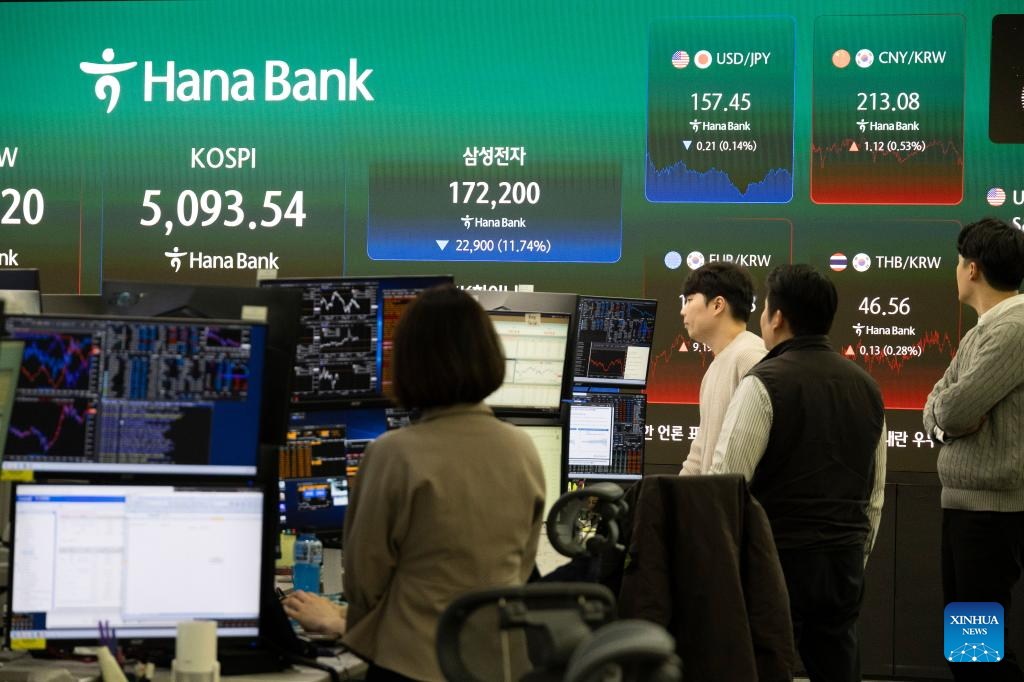
People work at the dealing room of Hana Bank in Seoul, South Korea, March 4, 2026. The Korea Exchange triggered circuit breakers on both the KOSPI and KOSDAQ markets following the severe market crash, caused by the escalating geopolitical tensions in the Middle East.
The benchmark KOSPI dived 698.37 points, or 12.06 percent, to close at 5,093.54, and the smaller KOSDAQ plunged 159.26 points, or 14.00 percent, to finish at 978.44.
Both the KOSPI and the KOSDAQ saw their steepest daily percentage drops in history. (Photo by Jun Hyosang/Xinhua)
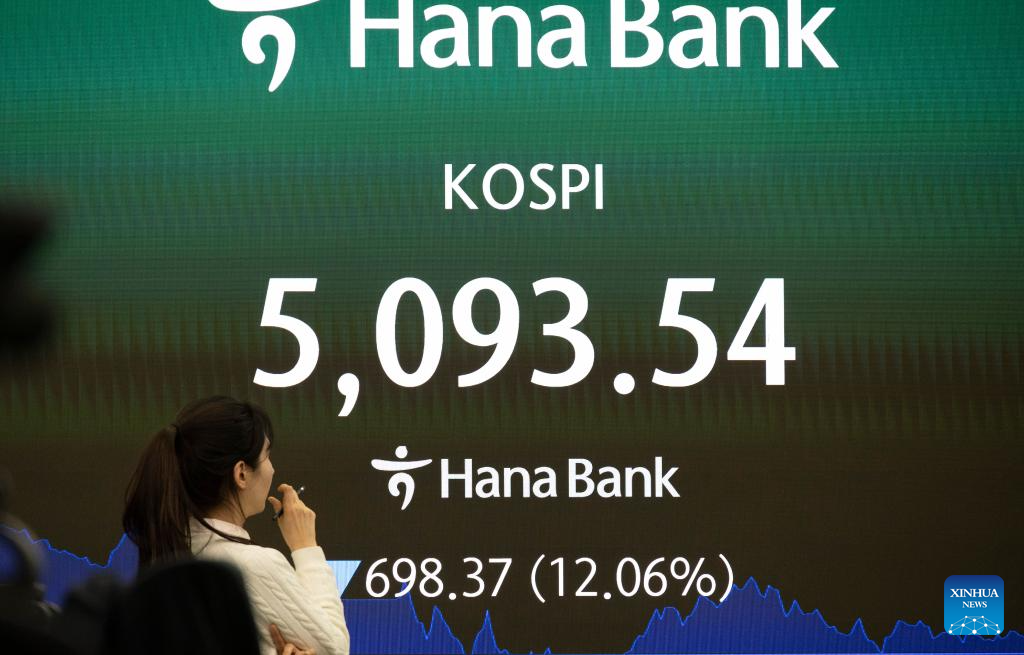
An employee works at the dealing room of Hana Bank in Seoul, South Korea, March 4, 2026. The Korea Exchange triggered circuit breakers on both the KOSPI and KOSDAQ markets following the severe market crash, caused by the escalating geopolitical tensions in the Middle East.
The benchmark KOSPI dived 698.37 points, or 12.06 percent, to close at 5,093.54, and the smaller KOSDAQ plunged 159.26 points, or 14.00 percent, to finish at 978.44.
Both the KOSPI and the KOSDAQ saw their steepest daily percentage drops in history. (Photo by Jun Hyosang/Xinhua)
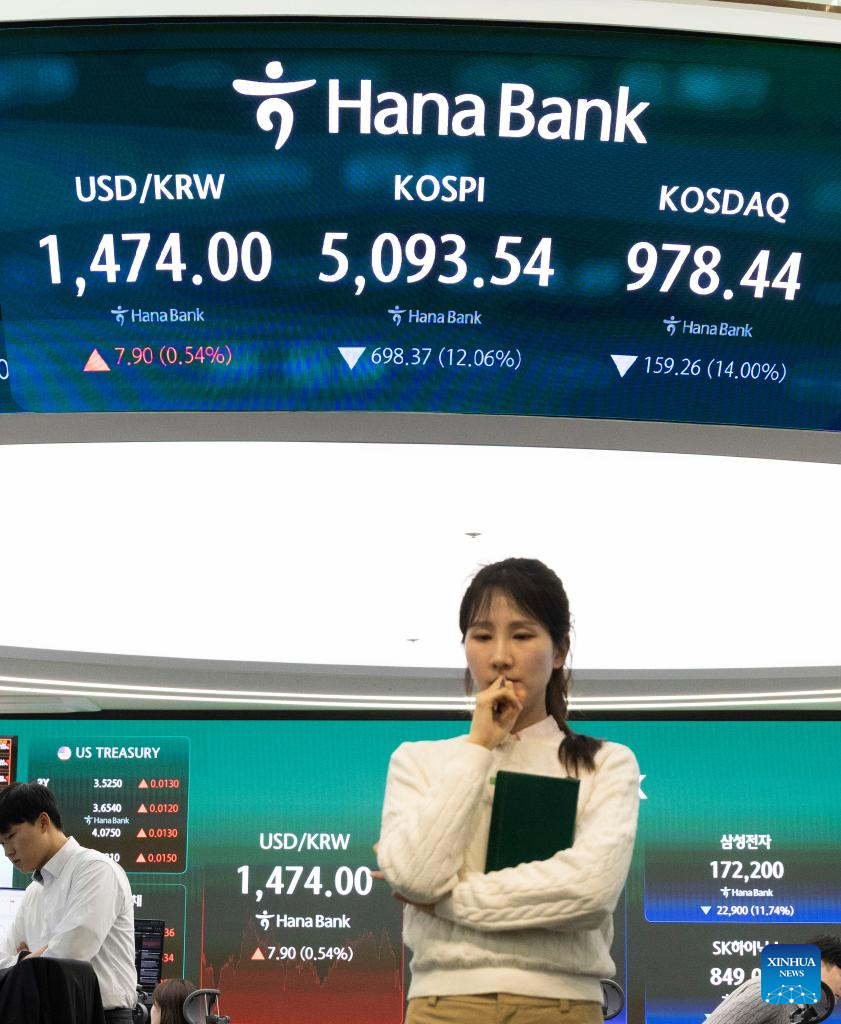
An employee works at the dealing room of Hana Bank in Seoul, South Korea, March 4, 2026. The Korea Exchange triggered circuit breakers on both the KOSPI and KOSDAQ markets following the severe market crash, caused by the escalating geopolitical tensions in the Middle East.
The benchmark KOSPI dived 698.37 points, or 12.06 percent, to close at 5,093.54, and the smaller KOSDAQ plunged 159.26 points, or 14.00 percent, to finish at 978.44.
Both the KOSPI and the KOSDAQ saw their steepest daily percentage drops in history. (Photo by Jun Hyosang/Xinhua)
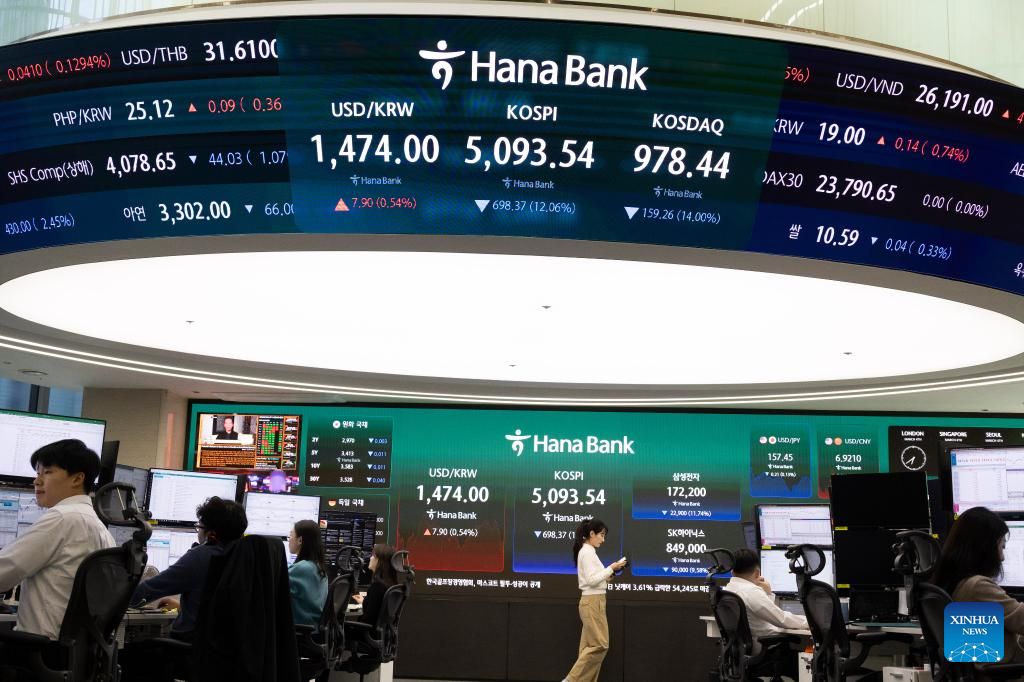
People work at the dealing room of Hana Bank in Seoul, South Korea, March 4, 2026. The Korea Exchange triggered circuit breakers on both the KOSPI and KOSDAQ markets following the severe market crash, caused by the escalating geopolitical tensions in the Middle East.
The benchmark KOSPI dived 698.37 points, or 12.06 percent, to close at 5,093.54, and the smaller KOSDAQ plunged 159.26 points, or 14.00 percent, to finish at 978.44.
Both the KOSPI and the KOSDAQ saw their steepest daily percentage drops in history. (Photo by Jun Hyosang/Xinhua)