



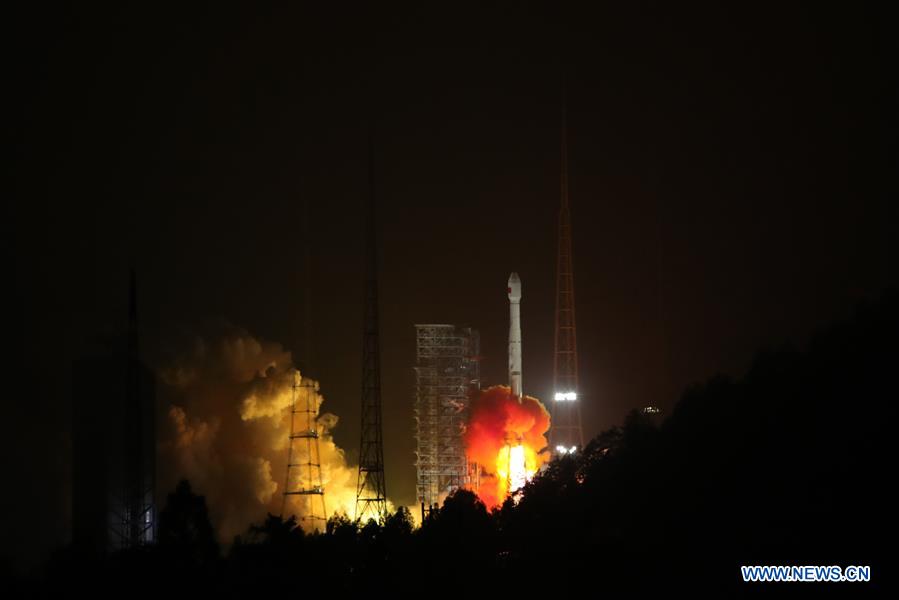
China sends twin BeiDou-3 navigation satellites into space on the Long March-3B carrier rocket from Xichang Satellite Launch Center, southwest China's Sichuan Province, Jan. 12, 2018. The twin satellites are coded the 26th and 27th satellites in the BeiDou Navigation Satellite System (BDS). (Xinhua/Liang Keyan)
XICHANG, Sichuan Province, Jan. 12 (Xinhua) -- China on Friday sent twin satellites into space on a single carrier rocket to help its BeiDou system provide navigation and positioning services to countries along the Belt and Road by late 2018.
The Long March-3B carrier rocket took off from Xichang Satellite Launch Center in the southwestern province of Sichuan at 7:18 a.m.
The twin satellites are coded as the 26th and 27th satellites in the BeiDou Navigation Satellite System (BDS).
This is the first launch of BeiDou satellites in 2018, which will see launches throughout the year.
China plans to send 18 BeiDou-3 satellites into space in 2018, according to Yang Changfeng, chief designer of the BeiDou system.
"The intensive launches will pose a great challenge. We must exercise strict control over quality specifications to ensure each of them is a success," Yang said.
Aiming to promote international use, China will move to incorporate BeiDou into the international satellite navigation system, enhance international cooperation, and make it compatible with GPS from the United States, European Union's Galileo, he said.
The satellites and the rocket for Friday's launch were developed by the innovation academy for microsatellites at the Chinese Academy of Sciences and China Academy of Launch Vehicle Technology, respectively.
Named after the Chinese term for the Big Dipper, the BeiDou project was formally launched in 1994. It began to serve China in 2000 and the Asia-Pacific region at the end of 2012.
By around 2020, when the BDS goes global, it will have more than 30 satellites.


