



 ?
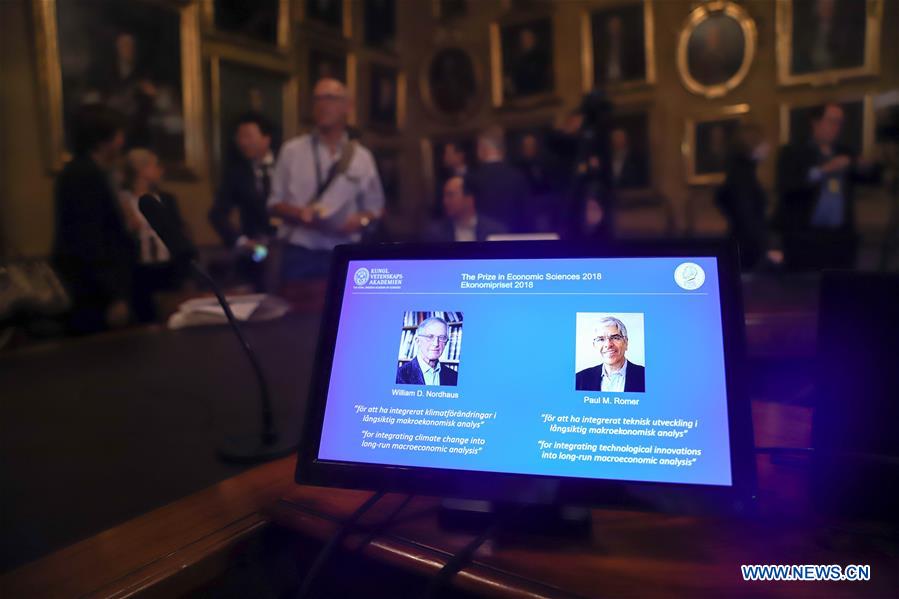
?Photo taken on Oct. 8, 2018 shows a screen displaying the portraits of awarded economists William Nordhaus (L) and Paul Romer of the United States, in Stockholm, Sweden. The 2018 Nobel Prize in Economics, or officially the Sveriges Riksbank Prize in Economic Sciences in Memory of Alfred Nobel, was awarded Monday jointly to William Nordhaus and Paul Romer. (Xinhua)
by He Miao
STOCKHOLM, Oct. 8 (Xinhua) -- The 2018 Nobel Prize in Economics, or officially the Sveriges Riksbank Prize in Economic Sciences in Memory of Alfred Nobel, was awarded Monday jointly to William Nordhaus and Paul Romer.
Nordhaus was rewarded "for integrating climate change into long-run macroeconomic analysis" and Romer "for integrating technological innovations into long-run macroeconomic analysis," according to an official statement released by the Royal Swedish Academy of Sciences.
The two American economists' findings have significantly broadened the scope of economic analysis by constructing models that explain how the market economy interacts with nature and knowledge, the statement added.
"I got two phones calls this morning, didn't answer any of them, thought they were spam," Romer told a press conference on site, "I didn't expect the Prize at all."
Responding to press question about this year's prize and climate change, Romer said, "Optimism helps to motivate people. The current situation is that many think it's too costly, so they deny the existence of climate change, I hope the Prize will help people to see through some policy changes we can make substantial progress without giving up chances of sustainable growth. I hope to see policy shifts and necessary progresses been taken."
"It's entirely possible for human to produce less carbon," Romer said while emphasizing that he was "a conditional optimist", that "if we start doing the right thing."
Previous macroeconomic research had emphasized technological innovation as the primary driver of economic growth, but had not modelled how economic decisions and market conditions determine the creation of new technologies. Paul Romer solved this problem by demonstrating how economic forces govern the willingness of firms to produce new ideas and innovations, according to the statement.
Romer's solution, published in 1990, laid the foundation of what is now called "endogenous growth theory". The theory is both conceptual and practical, as it explains how ideas are different to other goods and require specific conditions to thrive in a market. Romer's theory has generated vast amounts of new research into the regulations and policies that encourage new ideas and long-term prosperity. The statement added.
Nordhaus decided to work on this topic in the 1970s, as scientists had become increasingly worried about the combustion of fossil fuel resulting in a warmer climate.
In the mid-1990s, he became the first person to create an integrated assessment model, i.e. a quantitative model that describes the global interplay between the economy and the climate.
His model integrates theories and empirical results from physics, chemistry and economics, which is now widely spread and is used to simulate how the economy and the climate co-evolve. It is used to examine the consequences of climate policy interventions, for example carbon taxes, according to the statement.
"This year's Laureates do not deliver conclusive answers, but their findings have brought us considerably closer to answering the question of how we can achieve sustained and sustainable global economic growth," said the statement.
William Nordhaus, born 1941 in the USA, is Sterling Professor of Economics at Yale University, USA. Paul Romer, born 1955 in the USA, is Professor at NYU Stern School of Business, USA.
This year's prize is 9 million Swedish krona (about 1 million U.S. dollars), to be shared by the two laureates.


