



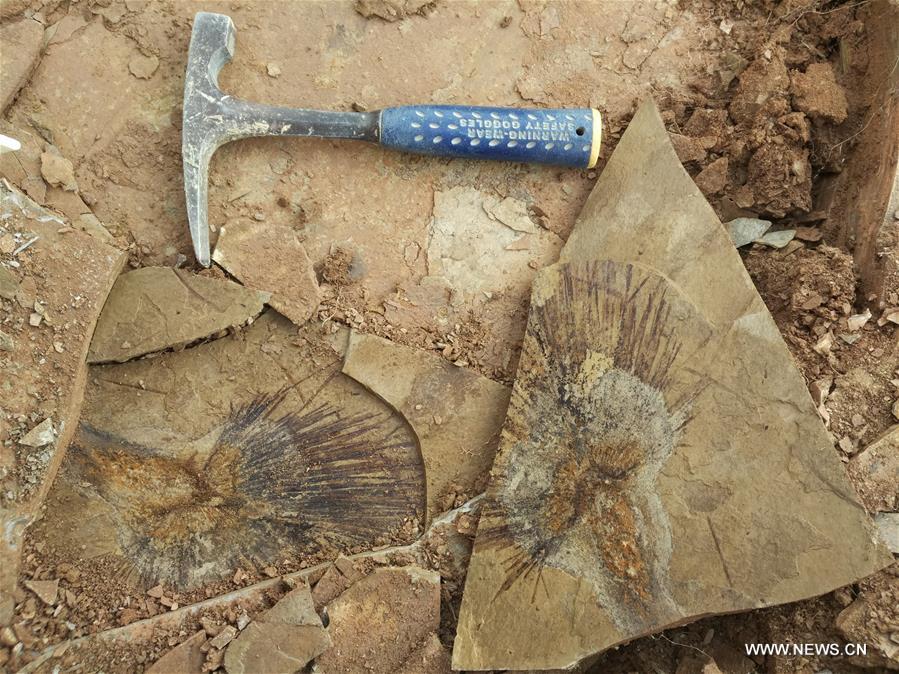
Undated file photo shows the fossilized palm leaves discovered at the layer of Lunpola Basin in southwest China's Tibet Autonomous Region. The discovery of fossilized palm leaves on the cold and high-altitude Qinghai-Tibet Plateau has led scientists to make new conclusions on when the plateau reached its current height. Su Tao, a leading scientist of the study from Xishuangbanna Tropical Botanical Garden, said the central part of the plateau did not reach its current altitude of about 4,500 meters until 23 million years ago. The conclusion challenges the prevailing view that the process happened about 35 million years ago, Su said. He said the judgment was based on the discovery of well-preserved palm fossils at the Lunpola Basin in central Tibet. By simulating a variety of topographic scenarios, the research team conjectured that about 25 million years ago, palm trees grew at a west-to-east valley flanked by high mountains in the central part of the plateau. (Xinhua/Su Tao)
BEIJING, March 7 (Xinhua) -- The discovery of fossilized palm leaves on the cold and high-altitude Qinghai-Tibet Plateau has led scientists to make new conclusions on when the plateau reached its current height.
Su Tao, a leading scientist of the study from Xishuangbanna Tropical Botanical Garden, said the central part of the plateau did not reach its current altitude of about 4,500 meters until 23 million years ago.
The conclusion challenges the prevailing view that the process happened about 35 million years ago, Su said.
He said the judgment was based on the discovery of well-preserved palm fossils at the Lunpola Basin in central Tibet.
Researchers from the Xishuangbanna Tropical Botanical Garden and the Institute of Vertebrate Paleontology and Paleoanthropology collected the fossil specimen during field tours as part of the second expedition on the Qinghai-Tibet Plateau.
The expedition started in 2017 and is expected to last for 5 to 10 years.
"It is very rare to find fossil palms on the Qinghai-Tibet Plateau because the plants are mainly distributed in tropical and subtropical regions and can hardly survive in high-altitude areas," Su said.
By simulating a variety of topographic scenarios, the research team conjectured that about 25 million years ago, palm trees grew at a west-to-east valley flanked by high mountains in the central part of the plateau.
"Then the plateau's central area gradually rose, reaching above 4,500 meters above sea level 23 million years ago and causing the valley to disappear," Su said.
The findings were published in Science Advances on Thursday.?


