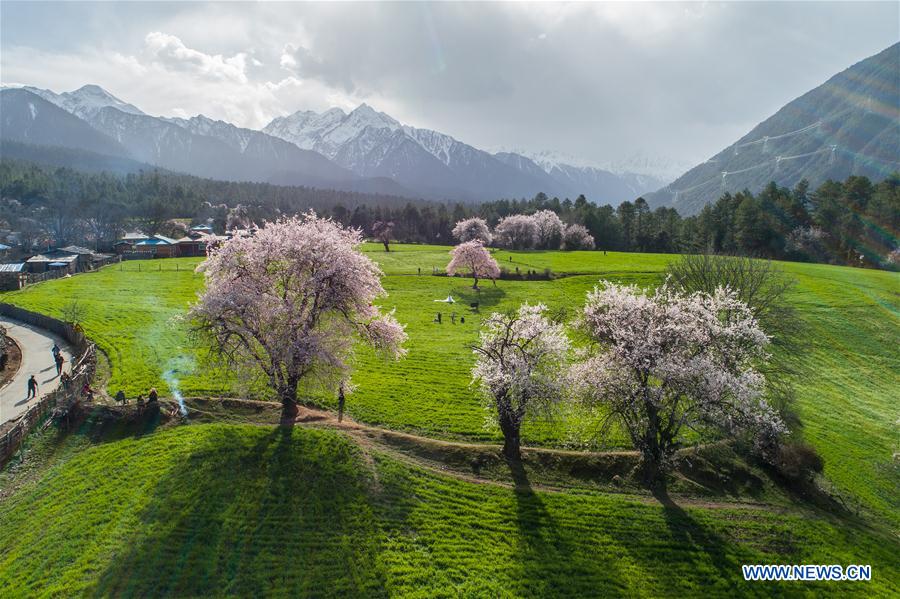
Photo taken on April 5, 2019 shows a village in Bome County of Nyingchi Prefecture, southwest China's Tibet Autonomous Region. Monitoring data provided by Chinese Academy of Sciences and departments on environmental protection shows that Tibet maintains a stable ecological structure in terms of its air, sound, water, soil, radiation level and ecological environment. With most areas remaining their original states in ecology, Tibet is one of the regions with best ecological conditions in the world. So far Tibet has established a well-distributed ecological environment protection network consisting of 47 nature reserves, 22 eco-function reserves, 4 national scenic areas, 9 national forest parks, and 22 national wetland parks. Since 2001, the government has paid 31.6 billion yuan (4.71 billion U.S. dollars) in eco-compensation for protecting forests, grassland, wetland, and key ecological reserves. Located in the main body of Qinghai-Tibet Plateau, Tibet is rich in wildlife resources, water resources, and mineral resources. (Xinhua/Li Xin)